White Cat: Blue Eyes, Deafness, Sunburn and White Breeds
Coat Colors & Patterns 6 min read reviewed November 2026, 6 sources

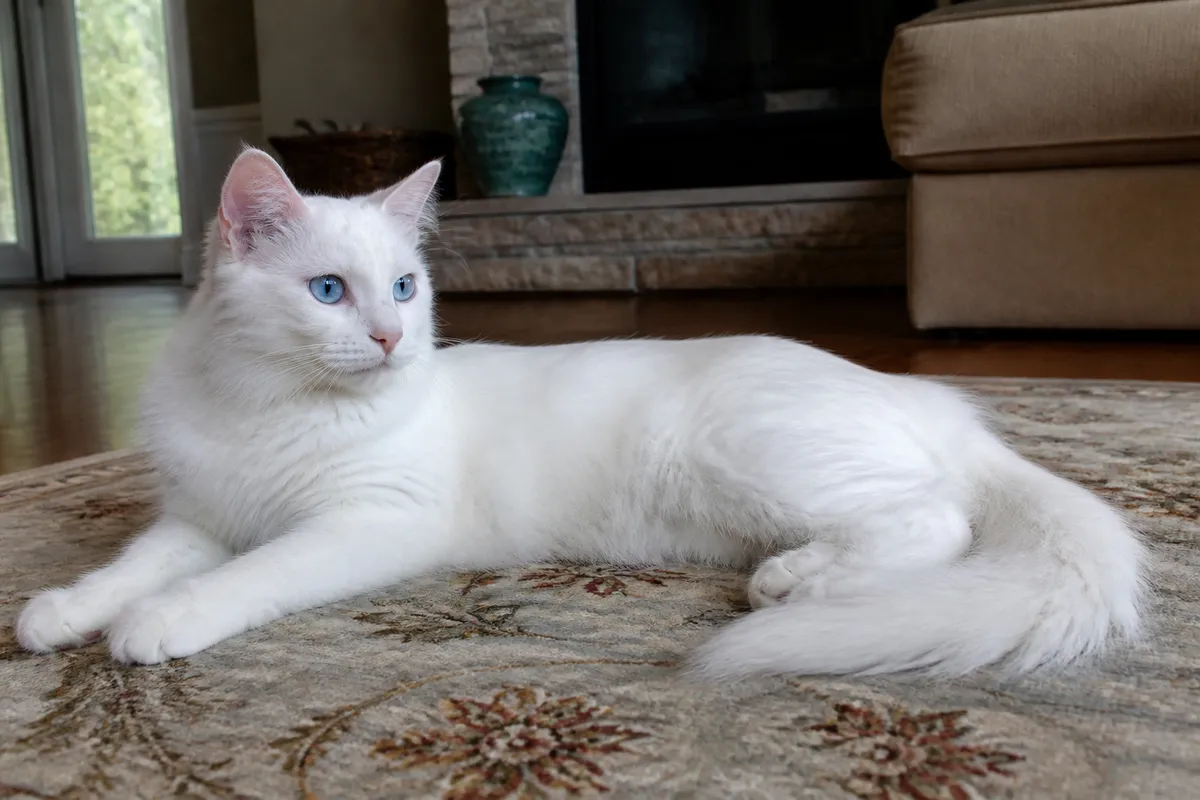
A white cat is usually white because of a single dominant gene that blocks pigment in the coat, and that same gene is linked to blue eyes and inherited deafness. White cats also face a higher risk of sun-related skin cancer on the ears and nose. Neither problem is a reason to skip a white cat, but both are worth knowing before you bring one home.
What makes a cat white?
Most solid white cats carry Dominant White, a variant of the KIT gene. A 2014 study published in G3 found that it shows complete penetrance for absence of coat pigmentation, meaning every cat with the gene has a white coat, whatever colors it carries underneath. A white cat can be genetically black, tabby or calico, you just can't see it. Its kittens with a colored partner may surprise you.
The same study found that white spotting, the gene behind bicolor and mostly white "van" cats, sits in the very same KIT gene. A cat with extensive white spotting can look almost entirely white but usually has a few colored spots, often on the head or tail.
If your mostly white cat has a colored smudge on the head or a colored tail, it's probably a high-white spotted cat rather than a Dominant White one. The difference matters mainly for breeders, because Dominant White carries the stronger link to deafness.
| Type | Gene | What you see | Deafness link |
|---|---|---|---|
| Dominant White | KIT (Dominant White variant) | Solid white coat, any eye color, often blue or odd eyes | Yes, strongest in blue-eyed cats |
| Extensive white spotting (van, high white) | KIT (white spotting variant) | Mostly white with small colored areas, often on head and tail | Weaker |
White cats with blue eyes: are they deaf?
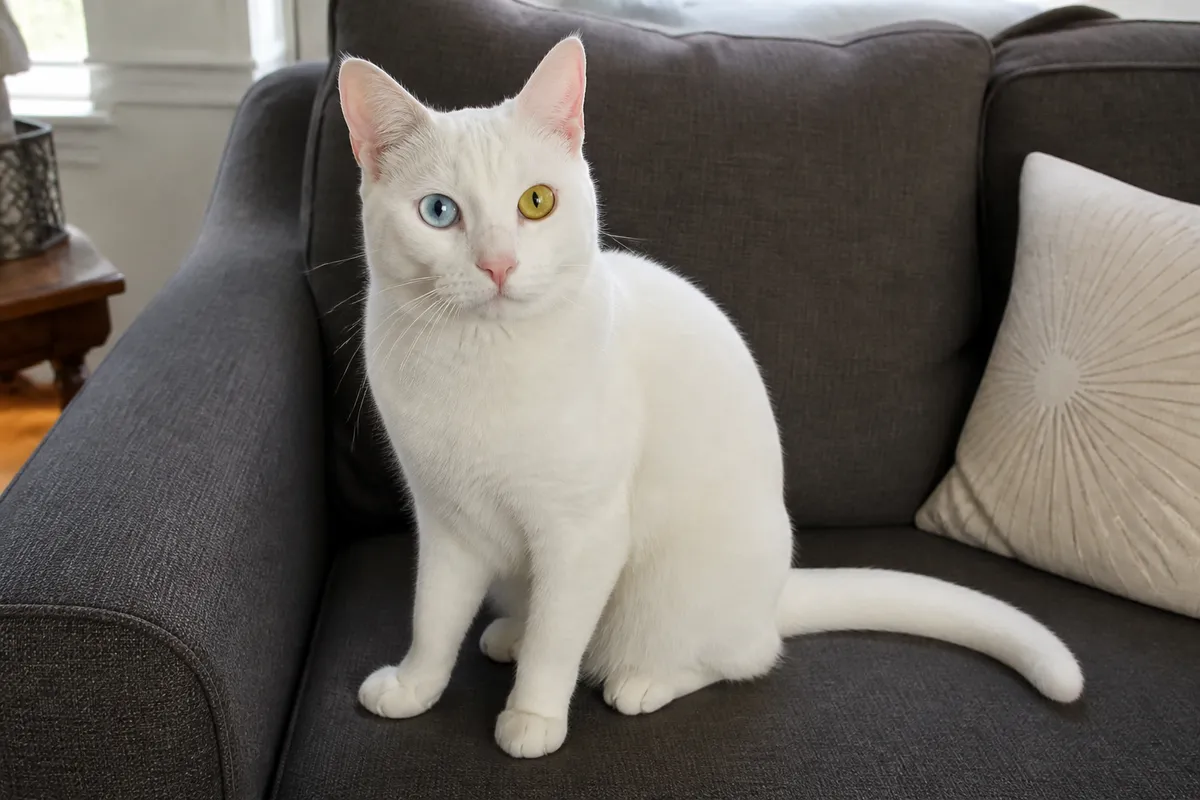
Not all, but many. The Cornell Feline Health Center says white cats with blue eyes are at the greatest risk for congenital deafness. Cornell surgeon Dr. James Flanders is quoted there: about 80 percent of white cats with two blue eyes will start to show signs of deafness when they're about four days old, due to degeneration of the inner ear (cochlea).
The 2014 KIT study explains why it's not 100 percent. Dominant White has incomplete penetrance for deafness and for blue eyes. In other words, the gene always makes the coat white but only sometimes affects the ears and irises. The study also found that cats with two copies of Dominant White were much more likely to have blue eyes.
Odd-eyed white cats, with one blue and one copper, gold or green eye, are common in breeds such as the Turkish Angora and Persian. Their hearing varies, so have it checked like any white cat's.
- White with two blue eyes: highest risk of deafness
- White with one blue eye: hearing varies, test it
- White with non-blue eyes: lower risk, but deafness still possible
- A hearing test called BAER, which your vet can arrange or refer you for, gives a clear answer, even in kittens
How to tell if your white cat is deaf
Deaf cats often compensate so well that owners don't notice for months. Common clues: the cat sleeps through the vacuum, doesn't come at the sound of the treat bag unless it can see you, or startles badly when you touch it from behind. Test gently by making a sound out of its line of sight, such as clapping in a doorway behind it, and watch whether the ears turn.
For a reliable answer, ask your vet about a BAER test (brainstem auditory evoked response). The Cat Fanciers' Association (CFA) notes that in some parts of the world, white Turkish Angora kittens must have a BAER test before sale, and that responsible breeders pair white cats with colored cats to reduce the chance of deaf kittens.
Living happily with a deaf white cat
Cornell notes that deafness in one or both ears is most often permanent, but deaf cats can live full, happy lives with a few adjustments. Their other senses, especially vibration and sight, take over a lot of the work.
- Keep your cat strictly indoors or in a secure catio, because it can't hear traffic, dogs or other dangers
- Never approach from behind without signaling first
- Announce yourself with vibrations, for example by stomping lightly on the floor or tapping a surface
- Replace verbal cues with visual ones, such as hand signals or flicking a light switch at mealtime
- Wake a sleeping deaf cat gently, by placing your hand near its nose or tapping the bed rather than touching it
- Add a tag that says "I am deaf" to the ID, so a finder knows why the cat doesn't respond
White cats and the sun: skin cancer risk
White fur over pink skin offers little protection from ultraviolet light. VCA Animal Hospitals says white and light-colored cats are more likely to develop squamous cell carcinoma (SCC), and outdoor cats are predisposed. The Washington State University Veterinary Teaching Hospital calls SCC the most common skin cancer in cats and says it typically develops on sun-exposed areas: the ears, nose, eyelids and lips.
Early changes are easy to mistake for a scratch. Look for reddened, scaly or crusty ear tips, a sore on the nose that doesn't heal, or a raised reddened area. WSU notes the prognosis is generally good if SCC is caught early and treated, and surgery offers the best chance of a cure, so don't wait and see.
- Keep white cats indoors during peak sunlight hours
- Use UV-blocking film or screens on the windows your cat sunbathes in
- Ask your vet about a pet-safe sunscreen for ears and nose, and use only what they approve
- Check ear tips and nose monthly and see your vet about any sore, crust or bump that lasts

White cat breeds and white fluffy cats
White is accepted in many breed standards. The CFA standards for Persians, British Shorthairs, American Shorthairs and Maine Coons all describe a pure white coat, often with blue, copper, gold or odd eyes.
The Turkish Angora has the strongest white tradition. The CFA calls it the oldest known longhair breed and explains that when Turkey set up preservation programs at zoos in the 1930s, only the white cats were considered authentic. The first Turkish Angoras that came to the US in 1954 were all white. Today they come in almost every color.
Looking for a white fluffy cat? The Persian and Turkish Angora are the classic choices, but they're very different to live with. The CFA says the Turkish Angora's silky single coat isn't prone to matting and needs combing only two or three times a month, while the Persian's long, full coat takes considerably more grooming. The Turkish Van, by contrast, is mostly white with color confined to the head and tail.
Adopting a white kitten
White kittens are beautiful, and shelters see plenty of them. Before you fall for the one with sapphire eyes, ask the shelter or breeder whether its hearing has been checked. A deaf kitten can still be a wonderful pet, but you'll want to know so you can plan for indoor life and visual cues from day one.
Plan for stain care, too. Tear stains and food around the mouth show more on white fur, so a soft damp cloth becomes part of your routine. Beyond that, a white kitten needs exactly the same food, vaccines and play as any other kitten.
Frequently asked questions
Are all white cats deaf?
No. Deafness is most common in white cats with two blue eyes, where Cornell cites about 80 percent showing signs of deafness. White cats with other eye colors are deaf less often, and many hear perfectly well.
Why do white cats have blue eyes?
The Dominant White gene that blocks pigment in the coat can also reduce pigment in the iris. It doesn't always do this, which is why white cats can have blue, green, gold, copper or odd eyes.
Do white cats get sunburned?
Yes, their thinly furred ears and nose can burn, and white and light-colored cats are more likely to develop squamous cell carcinoma. Limit midday sun, use UV-blocking window film and have any crusty or sore spot checked.
What breed is my white cat?
Most white cats are domestic shorthairs or longhairs. Breeds like the Turkish Angora, Persian, British Shorthair and Maine Coon also come in white, but only papers or a DNA panel confirm a pedigree.
Can a white cat have colored kittens?
Yes. Dominant White hides the colors a cat carries underneath. A white cat bred to a colored cat can have both white and colored kittens.
How can I tell if my white kitten is deaf?
Watch whether it reacts to sounds it can't see, like a clap behind it or a shaken treat bag in another room. For a clear answer, ask your vet about a BAER hearing test.
Sources
- Deafness, Cornell Feline Health Center
- Endogenous Retrovirus Insertion in the KIT Oncogene Determines White and White spotting in Domestic Cats, G3: Genes, Genomes, Genetics (via PubMed Central)
- Squamous Cell Carcinomas in Cats, VCA Animal Hospitals
- Feline cutaneous squamous cell carcinoma (FC-SCC), Washington State University Veterinary Teaching Hospital
- Turkish Angora breed profile and standard, The Cat Fanciers' Association
- Persian breed standard, The Cat Fanciers' Association
Last reviewed: November 2026