Black Cat: Genetics, Breeds, Superstitions and Adoption Myths
Coat Colors & Patterns 6 min read reviewed November 2026, 6 sources
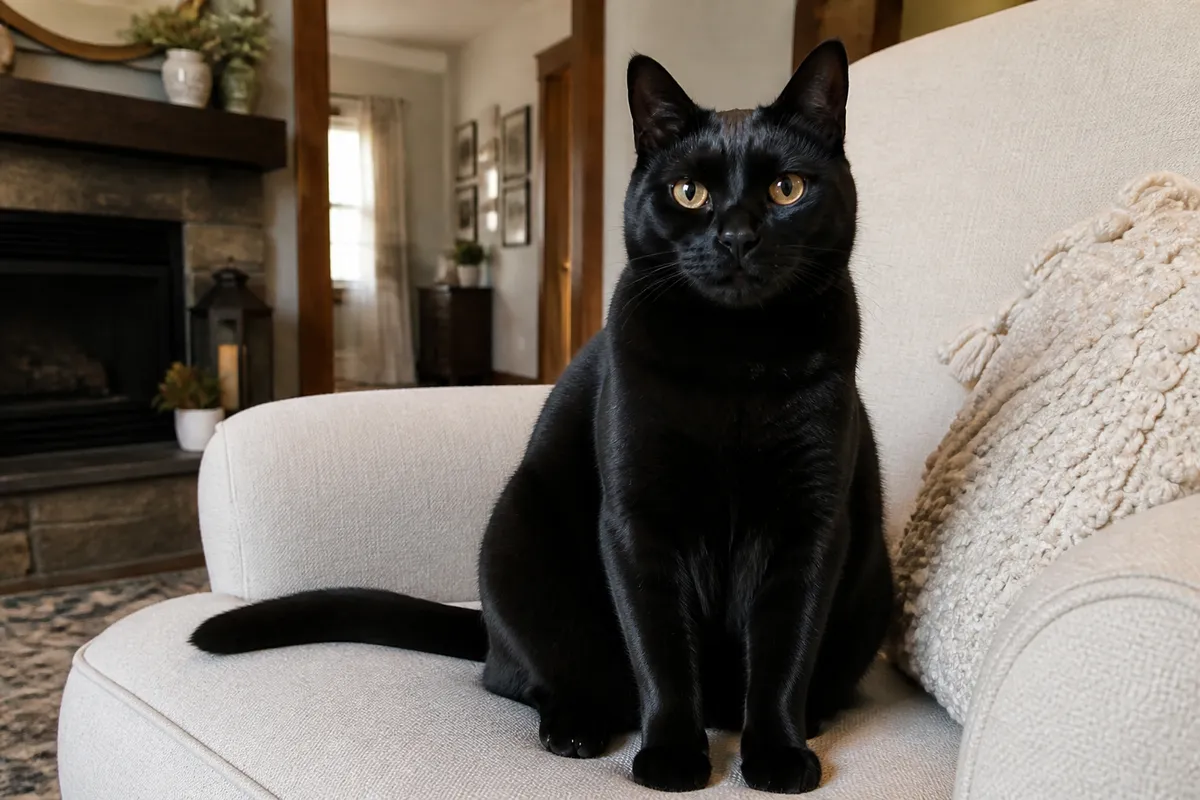
A black cat gets its color from a single recessive gene that switches off the tabby pattern, so it is a coat color, not a breed, and one of the most common colors in American homes and shelters. Below you'll find how the genetics work, which breeds come in black, where the superstitions came from and what the shelter data really says about black cats and adoption.
What makes a cat black?
Every cat carries tabby genetics somewhere. What decides whether you see stripes is the Agouti gene. The UC Davis Veterinary Genetics Laboratory explains that cats with two copies of the non-agouti version (written aa) are solid in color, and their tabby pattern becomes difficult to see. Pair that with the black pigment eumelanin and you get a solid black cat.
Because non-agouti is recessive, two tabby parents can still produce a black kitten if both carry the hidden copy. That's why black kittens pop up in litters of very mixed-looking cats. If the same cat also inherits two copies of the dilution gene, the black turns into the soft gray that breeders call blue. That gray coat has its own guide.
Look closely at a black cat in bright sunlight and you may still spot faint stripes or spots. These "ghost" markings are the tabby pattern showing through the solid color. They're common in kittens and often fade or become harder to see as the coat matures.
- Two copies of non-agouti (aa): solid color, tabby pattern hidden
- Black pigment plus aa: solid black
- Black plus two copies of dilution: solid gray (blue)
- Ghost markings: the hidden tabby pattern faintly visible, mostly in kittens
Black cat breeds: which breeds come in black?
Most black cats in the US are domestic shorthairs or longhairs, the lovely mixed-ancestry cats you meet in every shelter. If you want a pedigreed black cat, you have more options than you might think, because black is an accepted color in many breed standards.
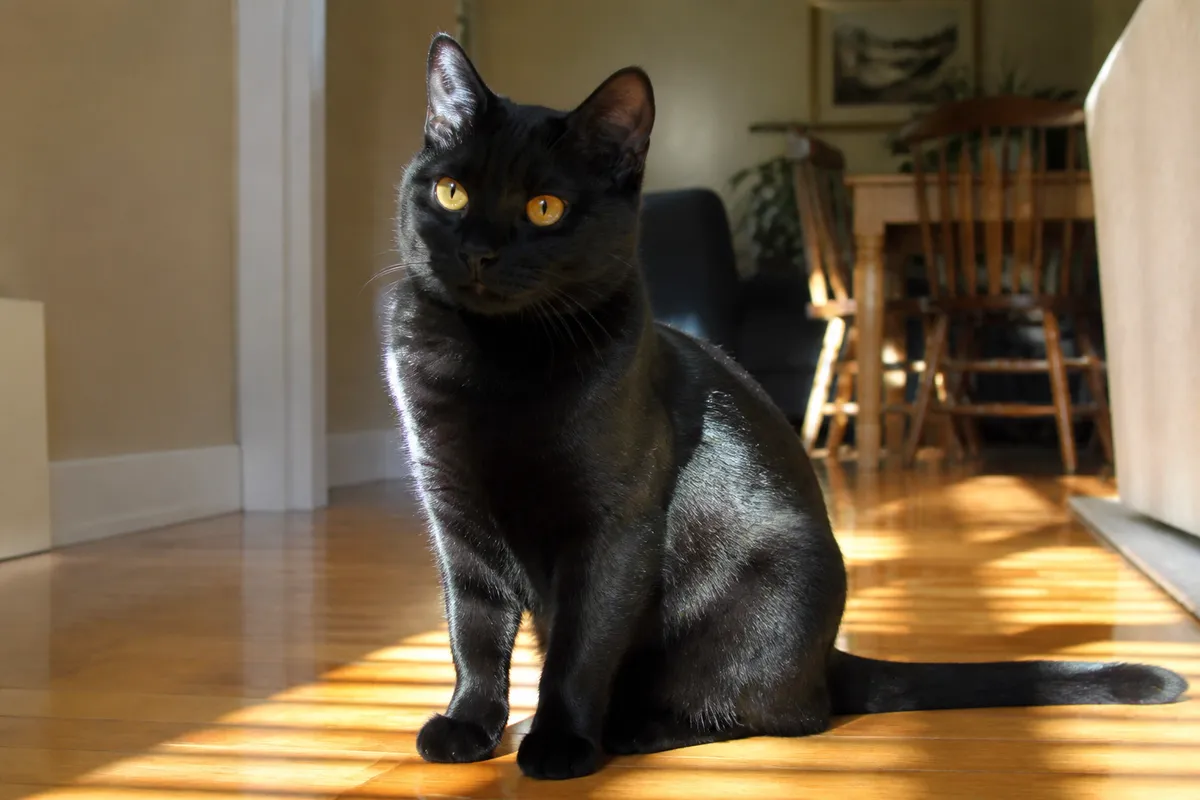
Only one breed is black by definition: the Bombay. According to the Cat Fanciers' Association (CFA), it was created by Louisville, Kentucky breeder Nikki Horner, who crossed a black American Shorthair with a Burmese to get a "parlor panther". Bombays were accepted for CFA registration in 1970 and advanced to championship status in 1976. The CFA describes them as outgoing, lap-loving cats with a gleaming black coat and gold to copper eyes.
| Breed | Black allowed? | What stands out |
|---|---|---|
| Bombay | Black only | Short, satin-like coat, gold to copper eyes, medium size |
| Maine Coon | Yes, solid black is a recognized color | Large longhair; standard asks for coal black with no rust tinge |
| Persian | Yes | Long flowing coat; standard calls for dense coal black |
| British Shorthair | Yes | Dense plush coat; black with gold or copper eyes |
| American Shorthair | Yes | Sturdy build; black with gold eyes |
Why does my black cat look brown or rusty?
Plenty of black cats show a reddish or brownish tinge, especially on the tips of the hair. Show judges know this so well that the CFA standards for black Maine Coons and American Shorthairs specifically ask for a coat "free from any tinge of rust on tips". In pet cats, a slightly rusty shine is usually just cosmetic.
A sudden change is a different story. If your black cat's coat changes color quickly, looks dull, thins out or feels greasy, mention it at your next vet visit, or sooner if your cat also eats, drinks or behaves differently. Coat changes can reflect diet or an underlying health problem, and your vet can tell the difference.
Black cat superstitions: bad luck or good luck?
Black cats haven't always had a bad reputation. Cats Protection, the UK cat welfare charity, points out that cats were worshipped in ancient Egypt and that killing one there was considered a capital crime. By the 17th century, though, cats were linked to witchcraft in Europe, and owning one could be taken as evidence in witch trials.
Today the meaning depends on where you live. In the United States, Belgium and Spain, black cats are still widely seen as unlucky, which is why they ride along with every Halloween witch. In the UK the opposite is true: a black cat crossing your path is considered good luck.
- Scotland: a stray black cat on your doorstep is a sign of prosperity
- England: a black cat given to a bride is said to bring good luck
- Southern France: treating a black cat well is believed to bring good fortune
- Italy: hearing a black cat sneeze is considered lucky
Are black cats really adopted less often?
This is one of the most repeated shelter myths, and the data doesn't back it up. HumanePro, the professional resource of Humane World for Animals, cites a 2013 ASPCA study: 33 percent of all cats entering shelters were black, and 31 percent of adopted cats were black. Black cats were adopted at about the same rate as other cats. There are simply more of them, so a shelter full of black cats can look like a shelter where nobody wants black cats.
Some shelters used to stop adopting out black cats around Halloween out of fear for their safety. Shelter leaders quoted by HumanePro now warn that those holds kept healthy cats in crowded shelters longer and did more harm than good. Most shelters have dropped them.
What black cats do have is a photo problem. Dark fur looks like a shapeless blob in a poorly lit picture, and many black cats look alike at first glance. Shelters have had success with colorful collars, bright beds and window light instead of flash. If you're browsing adoption listings, give the blurry black cat a second look in person.
Black cat personality: is there a link to coat color?
Black cats get called everything from mysterious to clingy, but there's no scientific evidence that coat color controls behavior. Stanford geneticist Greg Barsh said exactly that about orange cats in Scientific American, and the same applies here.
The only well-known study on the topic is an owner survey from UC Davis veterinarians, reported by Veterinary Practice News. More than 1,200 owners rated their cats. Calicos and tortoiseshells came out as the most likely to hiss or swat, while cats with solid coats were far less likely to be described as aggressive. The researchers never observed the cats themselves, so treat that as a fun hint rather than a rule. Your cat's personality comes from genetics, early socialization and life experience far more than from fur.
Living with a black cat or black kitten
Care is the same as for any other cat: good food, vaccines, play and regular vet visits. A few practical points come up again and again in black-cat households, though.
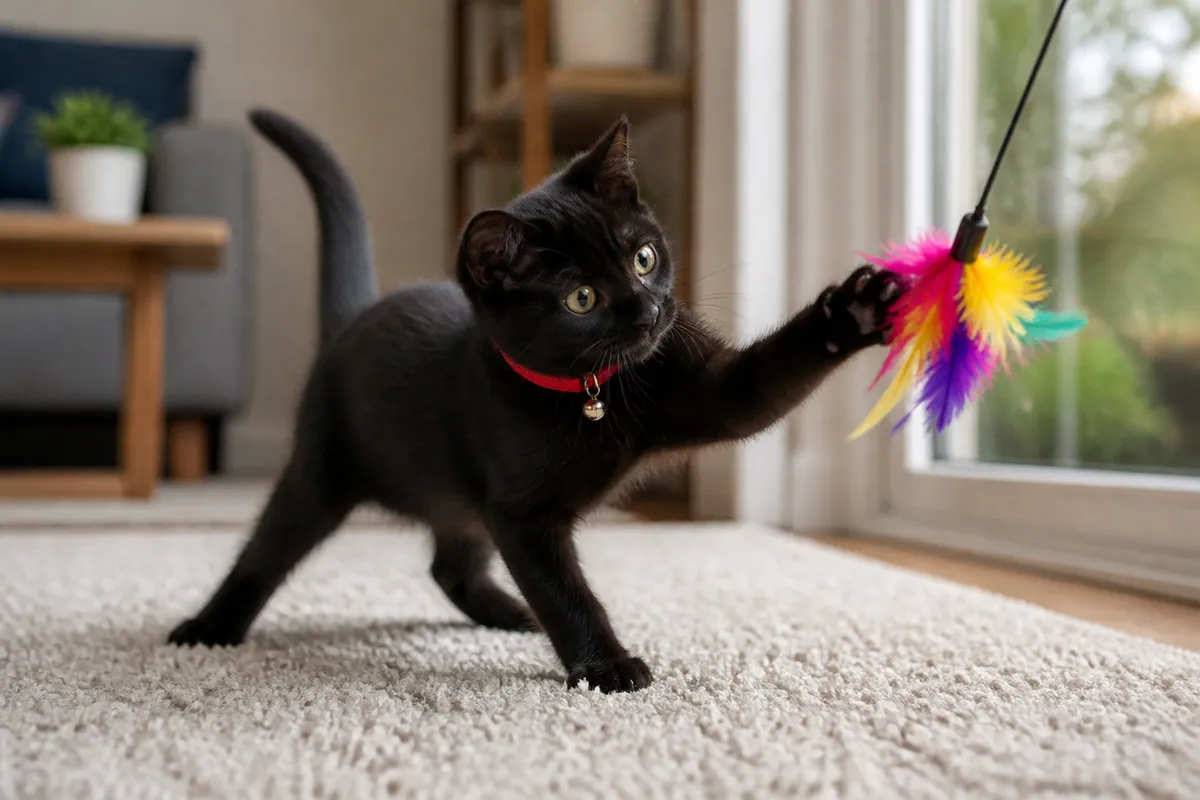
If you just brought home a black kitten, enjoy the ghost stripes while they last and start with the basics in our kittens guide. And yes, the shed hair will show up on light sofas. That's not a defect, it's a signature.
- Photos: shoot near a big window and skip the flash, which makes black fur look flat and yellowish
- Night safety: a black cat on a dark floor is easy to step on, so a night light in the hallway helps both of you
- Lost cat flyers: keep a few clear daylight photos that show any white hairs, scars or eye color, because "black cat" alone describes thousands of cats
- Microchip and ID: important for every cat, doubly so for one that looks like many others
- Lint roller: keep one by the front door
Frequently asked questions
Are black cats bad luck?
No. The bad luck belief comes from European folklore that tied cats to witchcraft, especially from the 17th century on. In the UK and parts of Europe black cats are actually considered lucky. A cat's color has no effect on your fortune.
Are black cats rare?
No, black is one of the most common cat colors. A 2013 ASPCA study cited by HumanePro found that about a third of cats entering shelters were black. Black is a coat color found in many breeds and in mixed-breed cats.
What breed is my black cat?
Most likely a domestic shorthair or domestic longhair, meaning a cat of mixed ancestry. The only breed that is always black is the Bombay. Many other breeds, including Maine Coons, Persians and British Shorthairs, can be black too, but without papers you can't tell a pedigreed cat from a lookalike.
Why does my black kitten have stripes?
Every cat carries a tabby pattern. In black cats it is mostly hidden by the non-agouti gene, but faint ghost markings can still show, especially in kittens and in bright light. They usually fade or become less visible as the coat matures.
Do black cats get adopted less?
Shelter data says no. In a 2013 ASPCA study, black cats made up 33 percent of shelter intake and 31 percent of adoptions, so they were adopted at roughly the same rate as other cats. There are just more of them waiting.
Do black cats have a different personality?
There is no scientific evidence that coat color determines personality. One owner survey from UC Davis rated solid-colored cats as less aggressive than calicos and tortoiseshells, but it relied on owner opinions, not observation. Every cat is shaped by genes, socialization and experience.
Sources
- Feline Coat Color, UC Davis Veterinary Genetics Laboratory
- Bombay breed profile and standard, The Cat Fanciers' Association
- The origins of black cat superstitions from around the world, Cats Protection
- Who's afraid of a big black cat?, HumanePro by Humane World for Animals
- Veterinarians Study Cat Coat Patterns, Discover Attitude in Certain Cats, Veterinary Practice News
- This Strange Mutation Explains the Mystifying Color of Orange Cats, Scientific American
Last reviewed: November 2026