Angry Cat: How to Read the Warning Signs and Calm Things Down
Behavior 5 min read reviewed November 2026, 2 sources
An angry cat almost always warns you first: flattened or swiveled ears, a lashing tail, dilated pupils, a hiss or growl. Most "angry" cats are actually frightened, overstimulated or in pain, and the safest response is the same in every case: stop what you're doing, give space, and let the cat calm down on her own terms.
Angry or scared? Two very different-looking cats
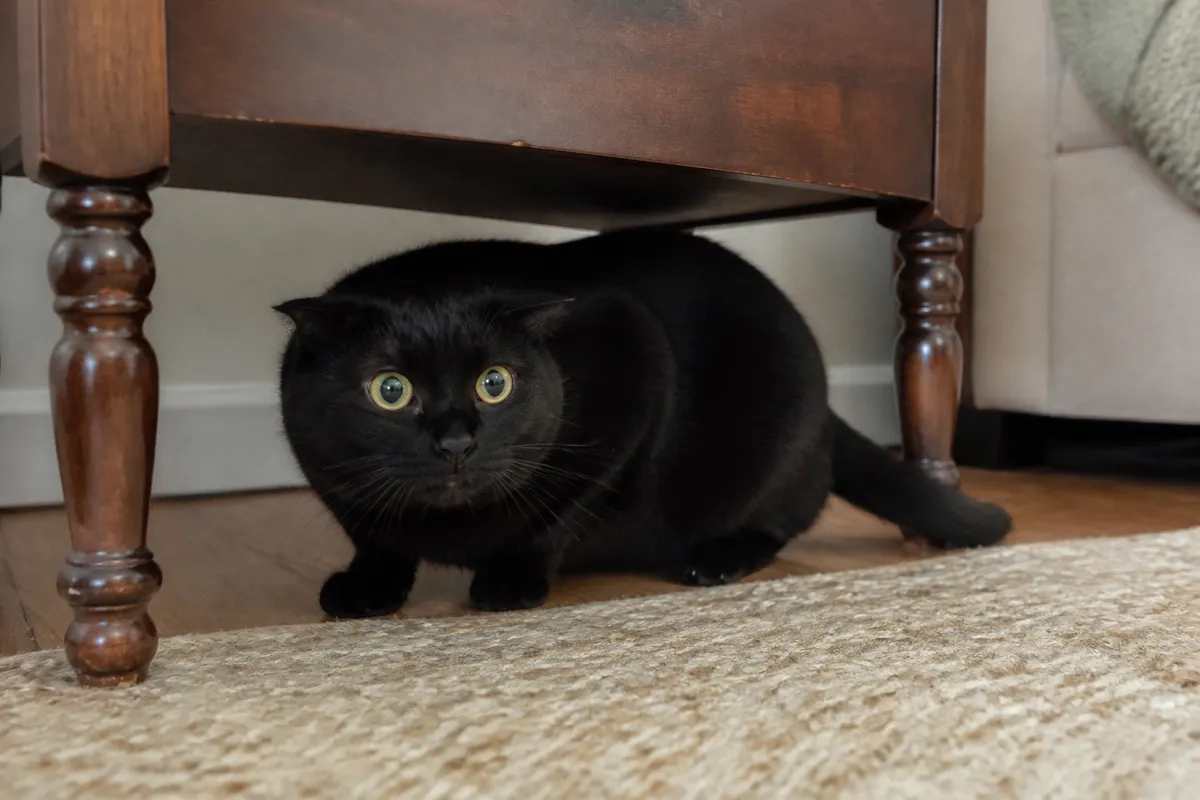
Behavior experts split the classic "scary cat" into two body languages. An offensive cat is trying to look bigger and is ready to move toward the threat. A defensive cat is trying to look smaller and would rather escape, but will fight if cornered. Both can bite, so neither is a cat to pick up.
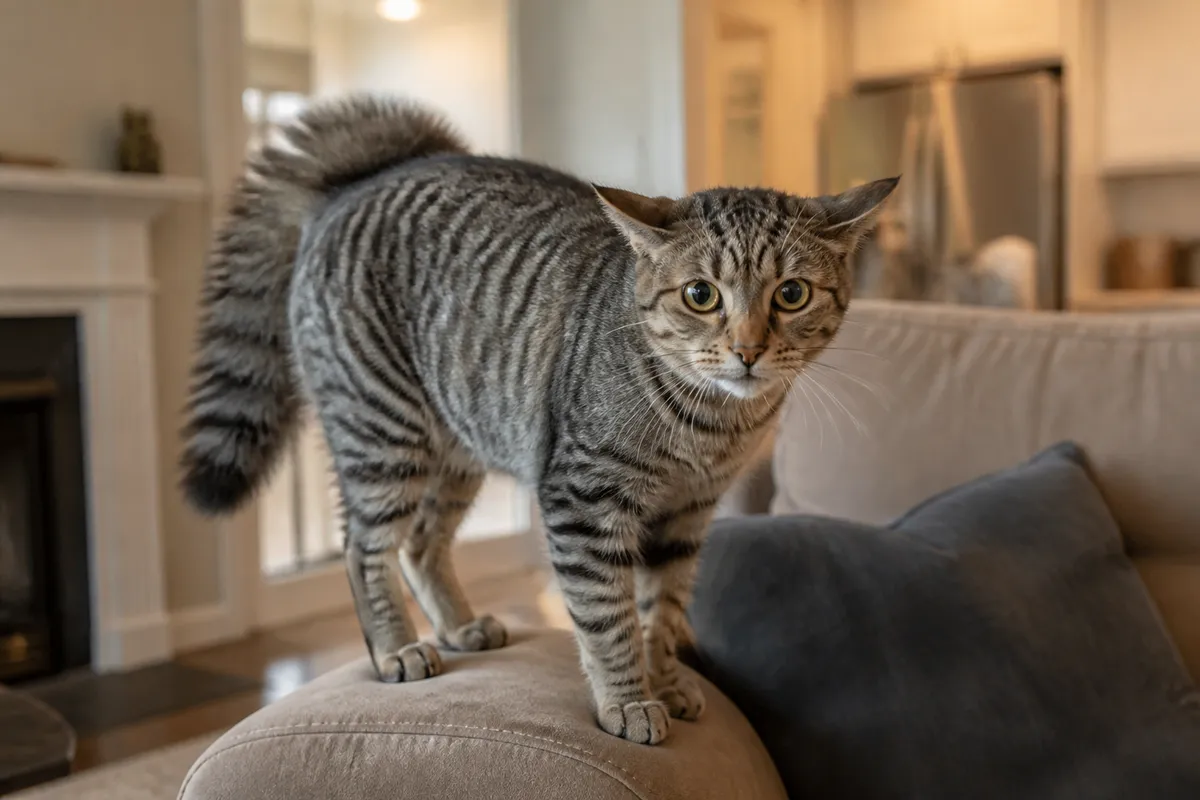
The Halloween-cat pose, arched back with fur standing on end, mixes both signals. It usually means a frightened cat who feels trapped and is bluffing hard. Give her an exit and most of the drama ends right there.
| Body part | Offensive ("back off or else") | Defensive ("I'm scared, leave me alone") |
|---|---|---|
| Posture | Stiff, upright, rear end raised | Crouched low, sideways stance, head tucked |
| Ears | Upright, often rotated outward | Flattened back against the head |
| Tail | Stiff and held low | Wrapped around or tucked under the body |
| Eyes | Direct stare, constricted pupils | Dilated pupils |
| Fur | Hackles raised | Fur may stand on end |
| Sounds | Growling, yowling | Open-mouthed hissing, spitting |
| Next move | Approaches, may attack | Quick paw swats; fights if it can't escape |
Early signs your cat is getting annoyed
Full-blown hissing is the late stage. The earlier signals are subtle, and learning them is the single best way to avoid scratches. If you see two or three of these together, the conversation is over for now.
- Tail twitching or thumping, especially during petting
- Ears turning sideways or back
- Head whipping around toward your hand
- Pupils suddenly getting large
- Restlessness, shifting position, a low growl
- Freezing and staring
Why cats get angry and lash out
Aggression in cats has a reason, even when it looks random. Knowing which type you're dealing with tells you what to change.
- Fear: an unfamiliar person, animal or noise, or a bad association such as the carrier that always leads to the vet. It escalates when the cat can't escape.
- Petting-induced: stroking that was pleasant becomes irritating, and the cat nips, then leaves. Biting gets its own guide.
- Redirected: the cat is worked up by something it can't reach, such as a stray cat outside the window, and takes it out on the nearest person or pet, sometimes hours later.
- Territorial: a new cat in the home, a kitten growing up, a big household change or strays in the yard.
- Play aggression: common in cats under about two years old, especially kittens weaned early or encouraged to attack hands and feet.
- Pain: even a gentle cat may lash out when a sore spot is touched or when she expects to be handled.
- Maternal: a mother cat guarding young kittens, especially in the first days after birth.
- Between cats: intact males competing, or cats reaching social maturity at around two to four years old.
How to defuse an angry cat right now
When a cat is hissing, growling or puffed up, your goal is not to win. It's to lower the temperature and keep everyone's skin intact.
Don't try to reassure her with petting or cuddling. A cat in an offensive or defensive posture shouldn't be touched at all, even with kind intentions. Most cats calm down faster alone in a quiet room than with an audience.
- Stop whatever you were doing, including petting, brushing or trying to lift her.
- Step back and give a clear escape route. Never corner a cat or block the door.
- Avoid staring. Look slightly away and move slowly.
- Keep hands, feet and faces out of reach.
- If you must move her, use a towel or slide a carrier into place instead of grabbing.
- Close curtains or block the view if a cat outside started it.
- Wait. Many cats need a long time to settle after a big fright, sometimes hours. Approach again only when the body language is relaxed.
Cat fights at home: what to do (and never do)
Never put your hand or any part of your body between fighting cats. Redirected bites happen in a split second and can be serious. Instead, startle them without touching: a loud clap, a thrown cushion landing near them (not on them) or a piece of cardboard slid between them.
Afterward, separate the cats into different rooms and let them cool down completely. If two cats who used to get along keep fighting, a slow reintroduction is usually needed; that process has its own guide on how to introduce cats.
Is my cat angry because something hurts?
Any cat who suddenly becomes grumpy, hisses when touched or starts lashing out should see a vet before you treat it as a behavior problem. Medical causes include arthritis, dental disease, an overactive thyroid, abscesses, injuries and nervous system problems. In older cats, failing senses and cognitive decline can make them startle and react more easily.
Treating the pain often fixes the temper. Tell your vet exactly when the outbursts happen and which body areas seem sensitive.
Long-term fixes for an angry cat
Keep a simple log for each incident: who was targeted, where, when, and what happened in the half hour before. Patterns appear quickly and point to the trigger.
Then manage the trigger. Block the window view of outdoor cats, stop petting at the first tail twitch, and play with wand toys so hands never become prey. For a fearful cat, give hiding spots up high and down low, and let her approach new people at her own pace, with a treat as the reward.
Never use physical punishment. It doesn't work, it increases fear and it can make aggression worse. If the aggression is frequent, intense or directed at children, ask your vet for a referral to a board-certified veterinary behaviorist or a certified applied animal behaviorist.
If an angry cat bites or scratches you
Cat bites can cause deep puncture wounds that easily become infected, and scratches can transmit cat scratch disease. Wash the wound well with soap and water and contact your doctor about any bite that breaks the skin, especially if it swells, turns red or hurts more over the next day.
Frequently asked questions
What does an angry cat sound like?
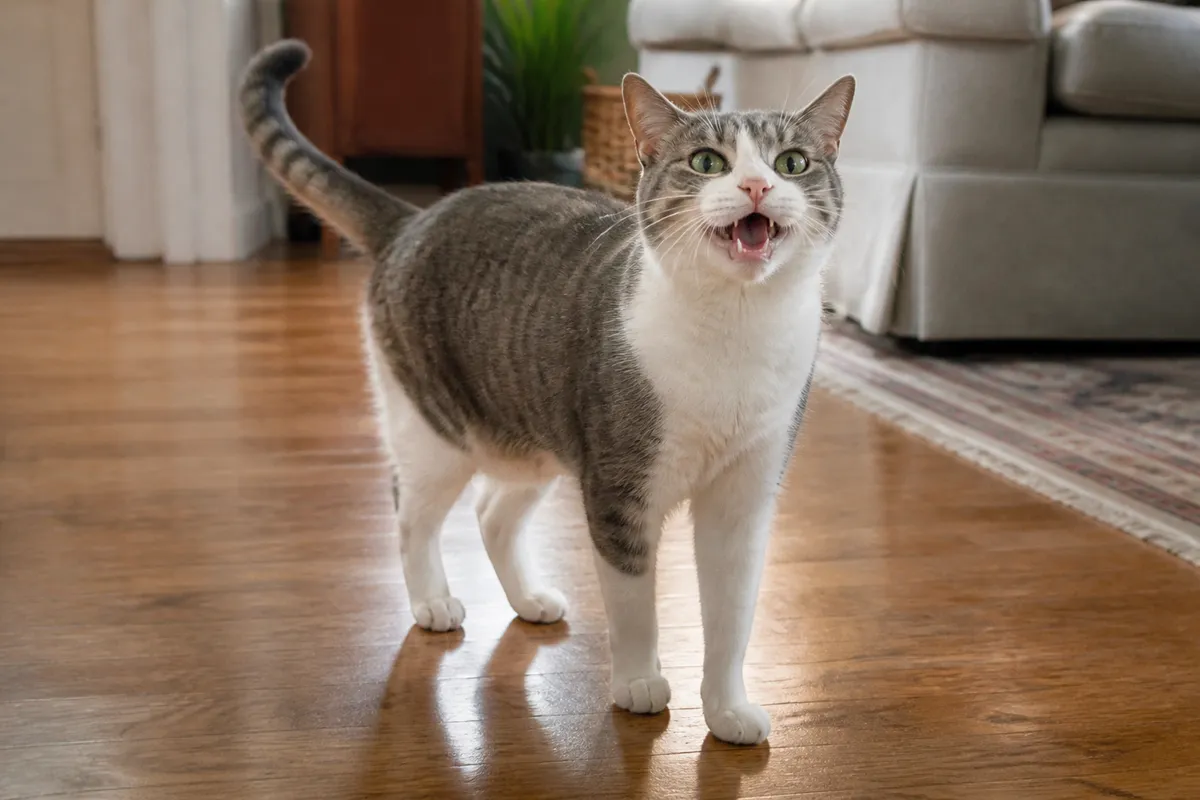
Growling, hissing, spitting and drawn-out yowls are the main angry or fearful sounds. A hiss with an open mouth usually means a frightened, defensive cat. A low growl with a stiff body is more of an offensive warning.
Why is my cat suddenly angry and aggressive?
Sudden aggression is often caused by pain or illness, or by redirected aggression after the cat saw or smelled something upsetting, like a stray outside. A vet exam is the first step, then look at what changed in the home.
How long does it take an angry cat to calm down?
It varies a lot. Some cats relax within minutes once you back off, while a cat who had a big fright or a fight can stay tense for hours. Let her come to you instead of checking on her repeatedly.
Should I hiss back at my cat?
No. Hissing back, yelling or swatting tells the cat you're a threat, which increases fear and makes aggression more likely. Calmly withdraw and give space instead.
Why does my cat attack me after looking out the window?
That's classic redirected aggression. The cat got worked up by another animal outside and released it on the nearest target. Block the view, discourage stray cats from the yard and avoid approaching your cat while she's staring outside.
Are some cats just mean?
Cats aren't spiteful. Most aggression comes from fear, pain, frustration or poor early socialization. Some cats are less tolerant of handling than others, and respecting their limits usually makes them much easier to live with.
Sources
- Aggression in Cats, ASPCA
- Feline Behavior Problems: Aggression, Cornell Feline Health Center
Last reviewed: November 2026